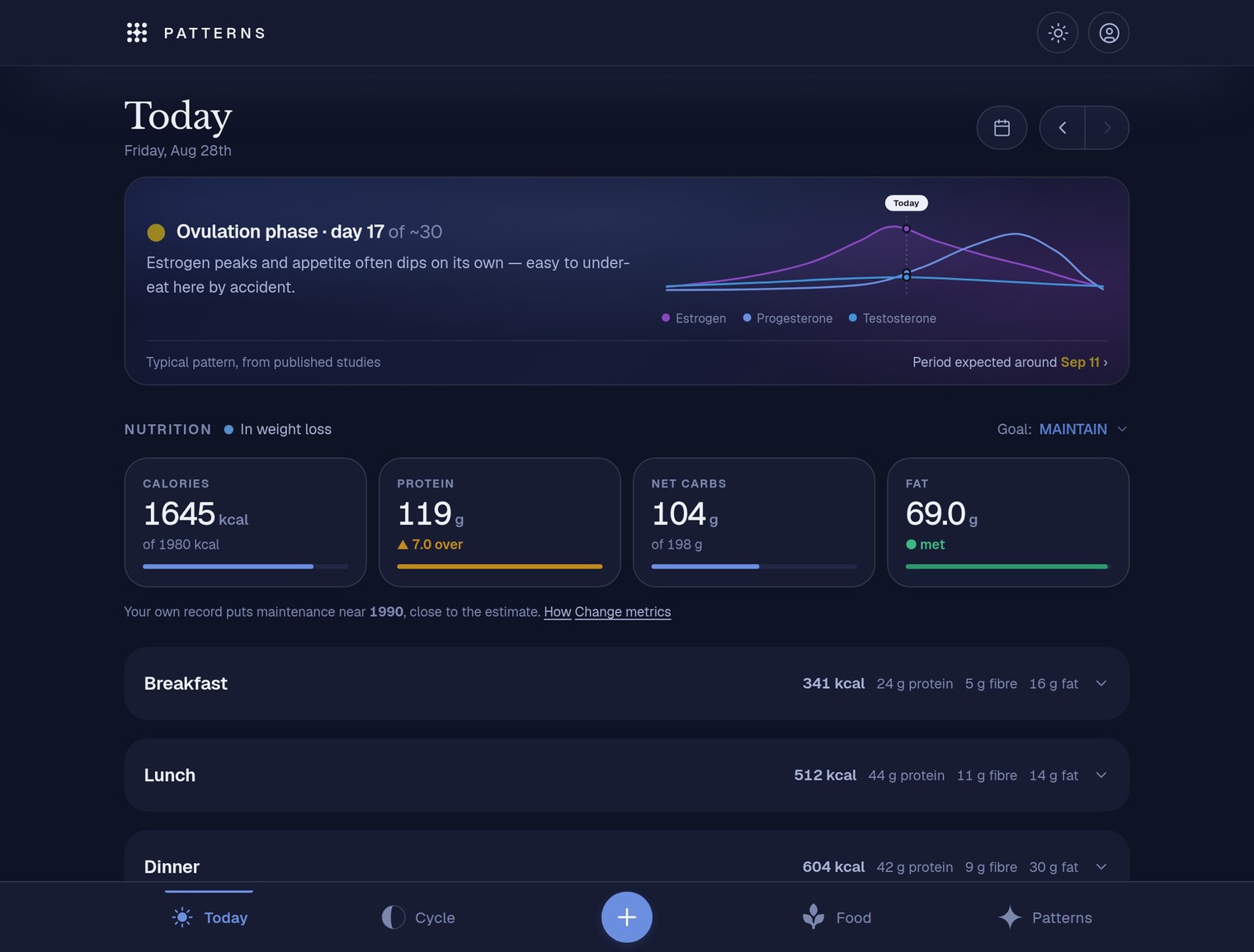
Your appetite, energy, mood and symptoms do not run on the same schedule every day. Patterns tracks your cycle alongside everything else — so you can see what actually changes for you.
Most period trackers tell you when your period is coming. Patterns uses your cycle as context for everything else you track.
See how calories, protein, fiber and the nutrients that matter move across your cycle.
Find recurring changes in mood, energy, cravings and symptoms — and how far ahead of your period they start.
See when training feels strongest, and when recovery takes more out of you than the session did.
Whether your sleep changes predictably through the month, or whether that is a story you have been telling yourself.
Your period begins. Track symptoms, energy, appetite and the nutrients you are actually losing — iron above all — alongside your usual food log.
Estrogen rises as your body moves toward ovulation. See what changes in your own appetite, mood and performance rather than what changes on average.
A short transition, estimated from your own cycle history — not assumed to be day 14, which is only true if your cycle happens to be 28 days long.
The stretch before your next period. Appetite and cravings commonly climb here; Patterns tells you what happens in your body, not in the average one.
Phase timing is estimated from your own cycle history. Where there is not enough logged to make a reliable estimate, Patterns says so instead of showing you a confident number it cannot support.
Knowing you are luteal is not, on its own, especially useful. Knowing that you consistently sleep worse, feel hungrier and eat less protein in the five days before your period is. That is what Patterns looks for.
Your calorie intake rose across the six days before your period in each of your last three cycles.
Your lowest mood scores cluster in late luteal days that followed a night under seven hours.
Your highest-rated strength sessions have landed in your follicular phase, four cycles running.
Patterns shows the observations behind every insight — how many cycles it looked at, how many of them agreed, and how large the change was — so you can decide whether a pattern means anything, rather than taking the app’s word for it. The questions it asks are written down in advance, and it reports the ones that came back flat too.
“You ovulate on day 14” is only true if your cycle is 28 days long. What is roughly steady between women and between cycles is the luteal phase — the stretch after ovulation, around fourteen days — so Patterns counts backwards from your next expected period rather than forwards from your last one.
The estimate is the median of your recent cycles, not a lifetime average and not a population default. Cycle length drifts with age, stress and weight.
Cycles change. Patterns adapts as yours does, and flags it when the spread between your shortest and longest is wider than usual.
One logged period is not a cycle length. Until the data supports an estimate, the app tells you it is running on the default — and on contraception that stops ovulation, it shows the reason instead of inventing a phase.
The reason people stop tracking is not the numbers — it is the twelve taps. Archie is a conversational assistant you can talk to: food, symptoms, mood, movement, medication, your period. He asks when something is missing rather than guessing.
Voice or text, your choice of personality, and nothing is recorded until you confirm it. Missing data is the thing that ruins pattern recognition, and a conversation is the cheapest way to fill the gaps.
Enter the first day of your last period and your usual cycle length. This is a small piece of the same engine running on one signal instead of six — it names your phase and tells you what is actually happening, what to eat today and why, and what kind of day to plan. Give it your own log and it stops guessing from averages.
Food. Cycle. Sleep. Mood. Movement. Health. Patterns brings them together to show you what changes, what repeats, and what works for your body.